Introduction
This book was written in Hindi - वोल्गा से गंगा (Volga se Ganga) by Rahul Sankrityayan. The author wrote the book while imprisoned in Hazaribagh central jail for his part in the Indian Independence Struggle. The First edition was released in 1943, the book I read was its 27th edition. I read its Tamil translation - வால்காவிலிருந்து கங்கை வரை (Volgavilirundhu Gangai varai), translated by K.N. Muthaiah in 1949, one of its earliest translations.
It is a collection of 20 short stories spanning over 8 millennia (6000 BC to 1942 AC) in the backdrop of Indo-Aryan tribe migration from Eastern Europe to Northern India via Central Asia. The book has 2 parts with 10 stories each. The first 10 stories are set in the BC era and the next 10 stories are AC. In this blog, I review the first part of the book.
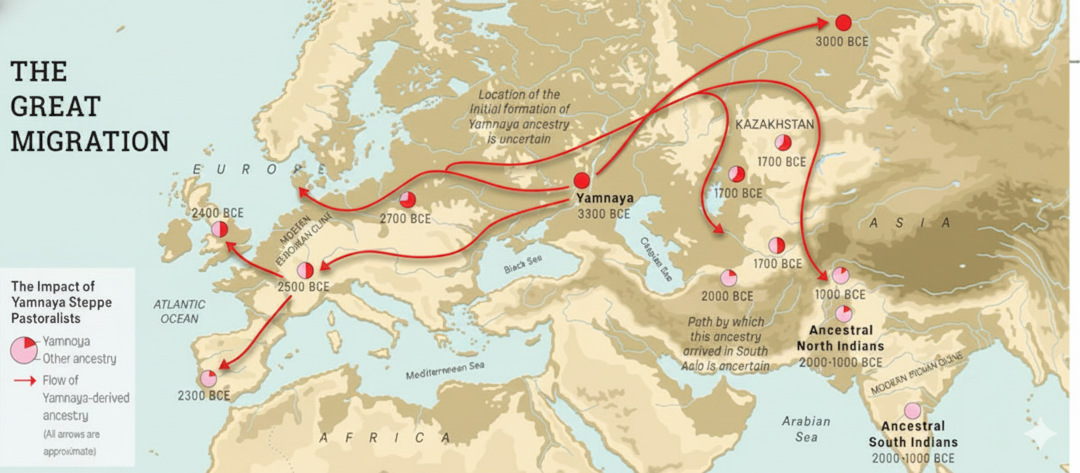
Image source: https://www.brownpundits.com/2019/12/20/why-aryan-migration-theory-amt-is-probably-true-but-it-might-not-matter/ enhanced by Google Gemini 3
The Stories and their themes
Hunter Gatherers
1. Nisha (6000 BC, Upper Volga)
This story sets the stage of what to expect from the author. It talks about the life of hunter gatherers 8000 years ago in the Volga river basin. The story is about the tribe matriarch Nisha. The author explains in detail about how they reproduced, how they hunted, what was their diet and what was their justice. This is a bold attempt and those who read this chapter will be hooked.
The Migration Begins
2. Diva (3500 BC, Middle Volga)
2500 years have gone. The tribes are still hunter gatherers but use stone-age tools. The leaders of the tribes are still matriarchs and they still mate with every male in the village without familial restrictions. The author sheds light on the limited resources for the numerous tribes that sprung around the river basin and it is a “kill or be killed” situation amongst the tribes for the fight for resources. Diplomacy is not a thing amongst humans in this period and we witness the first migration of a tribe eastward for survival.
The Shift towards Patriarchy
3. Amritashva (3000 BC, Fergana, Uzbekistan)
This story is fairly short. The migrating tribes have reached Central Asia, they are still pastoral, men and women are beginning to live together in their own huts as husband and wife but women can entertain guests as they see fit. So there isn’t monogamy-as-we-know-it yet. The author also points out that legal polygamy might have started during this time to manage women as spoils of war.
The Bronze Age
4. Puruhuta (2500 BC, The Oxus Valley, Tajikistan)
The migrating tribes have come in contact with a Bronze-Age civilization in the Oxus Valley in Tajikistan. There is technology sharing and trade between the two, and most importantly: The hunter-gatherers get to know about farming. The nice thing about this story (and this theme continues in the next two stories as well) is an old-age character lamenting about the destruction of tranditional values due to the introduction of new technology, in this case, farming. The story ends with a war between Indo-Aryan tribes and the Oxus Valley People, forcing the people to retreat further south-east into what is present day Iran.
An interesting fact pointed out by the author is how “Devas” and “Asuras” are common in both Persian and Indian mythologies but their roles are reversed - i.e. Asuras are gods & Devas are demons in Persian mythology but in Indian mythology the roles are reversed.
The author claims that the Oxus Valley civilization practised slavery, which might have been true but the constant rhetoric that every civilization other than the Indo-Aryans were slave traders gets old and reeks of the author’s racial bias.
The Asuras
5. Purudhana (2000 BC, Upper Swat Valley, Pakistan)
The contact with the Indus Valley Civilization is told as a matter of fact. It is told from the visiting Indo-Aryans point of view and they are full of contempt and hatred towards the people of IVC. The people are described as ugly, dark, stout, with stubby flat nose and curly black hair, practising slavery, prostitution, and as phallic worshipping hethens. The author does concede that they are great technicians, city builders, merchants, and administrators but the hatred is what remains. In this story the pastoral tribe continues to do what they did in every story - wage a war against the locals and drive them away.
The fall of Indus Valley Civilization
6. Angira (1800 BC, Gandhara, Pakistan)
The conflict with the Indus Valley Civilization continues in this story. The author calls the people of IVC as Asuras (demons. No relation to the Assurs of Mesopotomia), because that is how it is described in the Vedas. The last of the IVC cities have been captured and felled by the Aryans while continuing to attribute every single wrongdoing by the Aryans to the bad influence of the Asuras. There is a self-appointed morally superior old-age character that advocates for racial purity.
I was appalled by the racial bias of the author which continued for 3 stories. The author was born a Brahmin, gave up Hinduism and adopted Buddhism. He presents himself as a communist, an atheist and a world citizen. But his racial bias, as a member of the Indo-Aryan clan is visible as daylight. I disagree with his notion that Indo-Aryans were these “Warrior Poet Philosophers” who had great moral code but somehow got corrupted by the inferior civilizations, such as the Oxus and Indus Valley civilizations and if not for them, the Indo-Aryans would’ve established the most glorious civilization on earth. What made me continue the rest of the book is my own racial bias check, as a member of the Asura clan!
The Vedic Age
7. Sudhas (1500 BC, Kuru-Panchala, Western Uttar Pradesh)
The author establishes Gandhara as the one true racially pure region of the Indo-Aryans. The further eastward & southward you go, the purity takes a hit due to mixing with the local population.
This story is one of the Bollywood-style movies. A prince in disguise visits a village, falls in love with the local girl, the girl doesn’t know he is a prince, he promises to come back after attending to his aging parents, becomes a king, years go by, the king finally gets the chance to visit, but the girl died waiting for him. A classic. Historically, this period marks the beginning of the Vedic age in Northern India. The author opines that the Vedas were not truthful and is a conspiracy by the ruling class to keep themselves relevant and the serving class subservient. I found this take refreshing.
It is interesting to note the chronology of the Vedic period. The author places them after the end of the Indus Valley Civilization, which is also the commonly accepted view. This is a controversial topic for some Hindu nationalists as it conflicts with the choronology presented in the epic Ramayana. This makes the Vedic-era Indo-Aryans Outsiders. This goes against their propaganda that muslims are outsiders and India should belong to the Hindus.
Upanishads: Hindu Reforms
8. Pravahana (700 BC, Panchala, Uttar Pradesh)
The author’s hot take on Vedic traditions continue with this story and I love it, as it aligns with my views! In this story, Upanishads are introduced for the first time in Hindu theology. This story talks about the scholar-king Pravahana who invents Reincarnation as a concept to keep the poor from revolting, because it is easy to convince the poor that the reason for their poverty is their karmic debt from their previous life (and not the ruling class)! and if they want to change their karmic fate, they need to perform strict and impossible tapas. To be honest, I never understood the upside of Reincarnation and the karmic cycle either. It only serves to keep the unfortunates from asking questions about their sad situation.
For what its worth, reincarnation is only one of the several new philosophies introduced in the Upanishads that are still held with great reverence.
Slavery
9. Bandhula Malla (490 BC, Kusinara and Mallagrama, Uttar Pradesh)
This story happens in th backdrop of Gautama Buddha’s rise. It talks about slavery. It is a very poignant story (and again, very Bollywood-y) of a slave-turned free man military general. He had to constantly fight against biases, prejudices from his own people and has his loyalty tested in the place of his work. The author detests slavery and makes sure it is known in his stories. One cannot be sure whether anti-slavery thought was even a thing or if it was this strong in those times. Slavery was practised in India till the British period who abolished it with the Anti-Slavery Act in 1840s.
The author presents Buddha as an atheist and his only flaw is in preaching Samsara (rebirth). He attributes Buddha’s position on Rebirth to the societal pressures of his time, and how a true atheistic thought would not have produced many followers for his movement.
The Rise of Empires
10. Nagadatta (335 BC, Gandhara, Pakistan)
This story is present only to highlight Darius and Alexander’s conquest of the east which reached till North-Western India. The author has two characters debate whether a coalition of city-state republics like the Hellenic League in Greece is better than a large empire under a Monarchy. The debate ends with the reluctant acceptance that Monarchy is inevitable since a city-state coalition fails due to lack of altruism. The characters meet with King Darius of Persia and unsurprisingly hate his lavish lifestyle and use of slaves. This is also one of Bollywood style love stories and a good one at that. I am beginning to think Bollywood just recyles.
Conclusion
A worthy read. The author places stories on key historical periods to make a point and the stories themselves are a treat to read - most of them. Though at times the author’s racial bias shows in how he portrays the Indo-Aryan race and the local population they despise. He also claims the Vedas and Upanishads were untruthful ploys to keep the poor from revolting against the ruling class. With these two actions, had the book been released now, he would’ve alienated both the extreme left and extreme right - a rare feat.