This is not a review but more of an experience report of the game Clair Obscur: Expedition 33. It contain spoilers.

The world of Lumiere (Photo from expedition33.com)
Gameplay
It is a turn-based RPG with realtime dodging, parrying and call to actions. I’ve tried to get into Persona 5 and that felt like a chore, but this one was refreshing. There are inspirations from other games (Persona, Final Fantasy, Souls-likes), but they owned it and made something fresh. It has a pseudo-open world - i.e. you get to choose which region you want to explore, but the gameplay is linear in that region. Enemies can be skipped if you run fast enough. The confusing part was pictos. I didn’t really understand how to use pictos until the end of Act 1! Then I watched a youtube video and I was like “I’ve been playing it all wrong”.
Game Mechanics
Coming from “mastering” Sekiro, I couldn’t come to terms with the parry system in this game. Sekiro taught me to parry at the last millisecond before an attack lands, in this game, one should parry the moment the enemy finishes winding up for the attack. I never really mastered it, I barely kept it together till end of Act 2 on normal difficulty. I survived with dodging which is more forgiving. I switched the difficulty to Story mode for the Act 2’s final boss fight and completed Act 3 in one sitting - not because I couldn’t win, but because I really, really, really wanted to know what is going on with the story. You don’t get the full picture till the end of Act 2 and I couldn’t hold on to the suspense. The difficulty is tough but fair for the most part. Some boss fights have elaborate “dances” with delays, but there isn’t any penalty on death, one can just retry the boss multiple times and learn the moves.
I lost the will to engage with the game the moment I won a boss in story mode. It was laughably easy, I missed the challenge, the dying, the “last stand” fights, the satisfaction of a good fight. I hear people say “story mode is plenty of difficulty”, which is surprising to me. Maybe this game’s story was so good that it brought in non-gamers to play the game. Like, it is to “vibe gaming” what LLMs are to “vibe coding”.

Turn-based Combat with real-time actions (Photo from expedition33.com)
Story
If I have to summarize in one line, it is “Inception meets Matrix in the early 20th century Paris, with your take on the Trolley Problem”.
Like I said, one wouldn’t get the full gist of the story till the end of Act 2, which is almost 15-20 hrs of gameplay. It is both its strength and weakness because the reveal is the most fun part, but I couldn’t afford to spend hours on one boss fight (and my wife HATES if I spend all my nights playing video games. She is reasonable though). The characters are likeable, the side quests are meaningful. The voice acting, animation, music, enemy design, game mechanics, game art - everything was of the highest quality and more importantly they made the end product better. It was like being in a movie with engaging gameplay. The game world is bright and beautiful. There are different terrains and several NPCs to befriend.
The Two Endings
The most polarizing discussion on online forums is about the two endings in the game. The game makes it known in no ambigious terms on which ending it prefers. I agree with the game’s preference and thought Maelle’s ending was horrific. I expected the internet to agree with me (which for the majority, it did). But, I was surprised by how strong some people defended the ending where Maelle decides to live in the canvas indefinitely. Their argument is that one man’s suffering is worth the sacrifice to save the canvas (world) from destruction. The core of the debate is whether the people of Lumiere have a will of their own? Are they human? If not, why not? What makes one human? For what its worth, they seem to have free will. They laugh, cry, have social order, procreate, invent, discover, etc. - just like “us”.
I couldn’t deny any of these arguments. But then, Maelle literally becomes the Paintress, she plays God with dead people, bringing them to life and everyone seems ok with it. Why? And does Lumiere know that they are living in a simulation? At least Lune, Sciel, Sciel’s husband and Gustav and his girl friend (assumed) know. How are they ok with it? Like, there would be chaos in our world if we know with 100% certainty that we are all manifestations living in a simulation. Is being outraged to learn that one lives in a simulation part of the simulation?
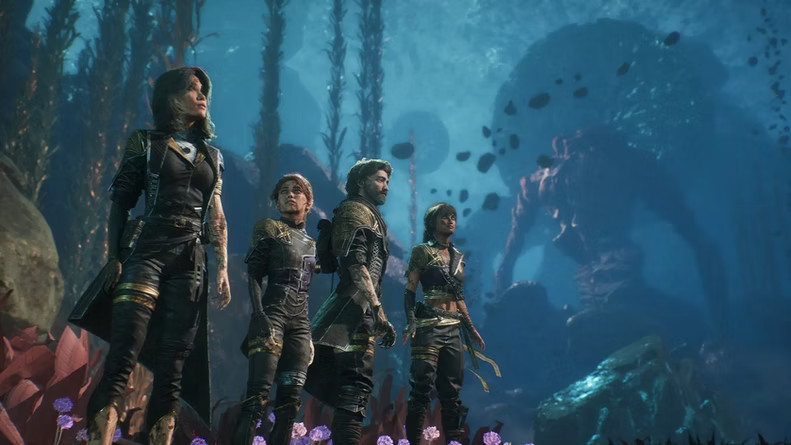
The Expedition 33 crew (Photo from expedition33.com)
Reasonable people concluded that both the endings are sad in their own way and the only happy ending was to a) let Maelle live in the land of the living b) Let Verso’s soul rest in peace and, c) preserve the canvas so the people of Lumiere continue to live in the simulation. The problem is, points b and c cannot co-exist becaue apparently the canvas is Verso’s soul. Maelle cannot leave because if she leaves, Verso will most likely unlive himself, but thats not the reason why she decides to stay. She stays because she matters in the canvas. In the real world, she is one-eyed, scarred and lost her speech.
So, all in all, a tremendous game. I envy the person who will be playing this game for the first time without knowning anything about the story. This game deserves all the awards.